
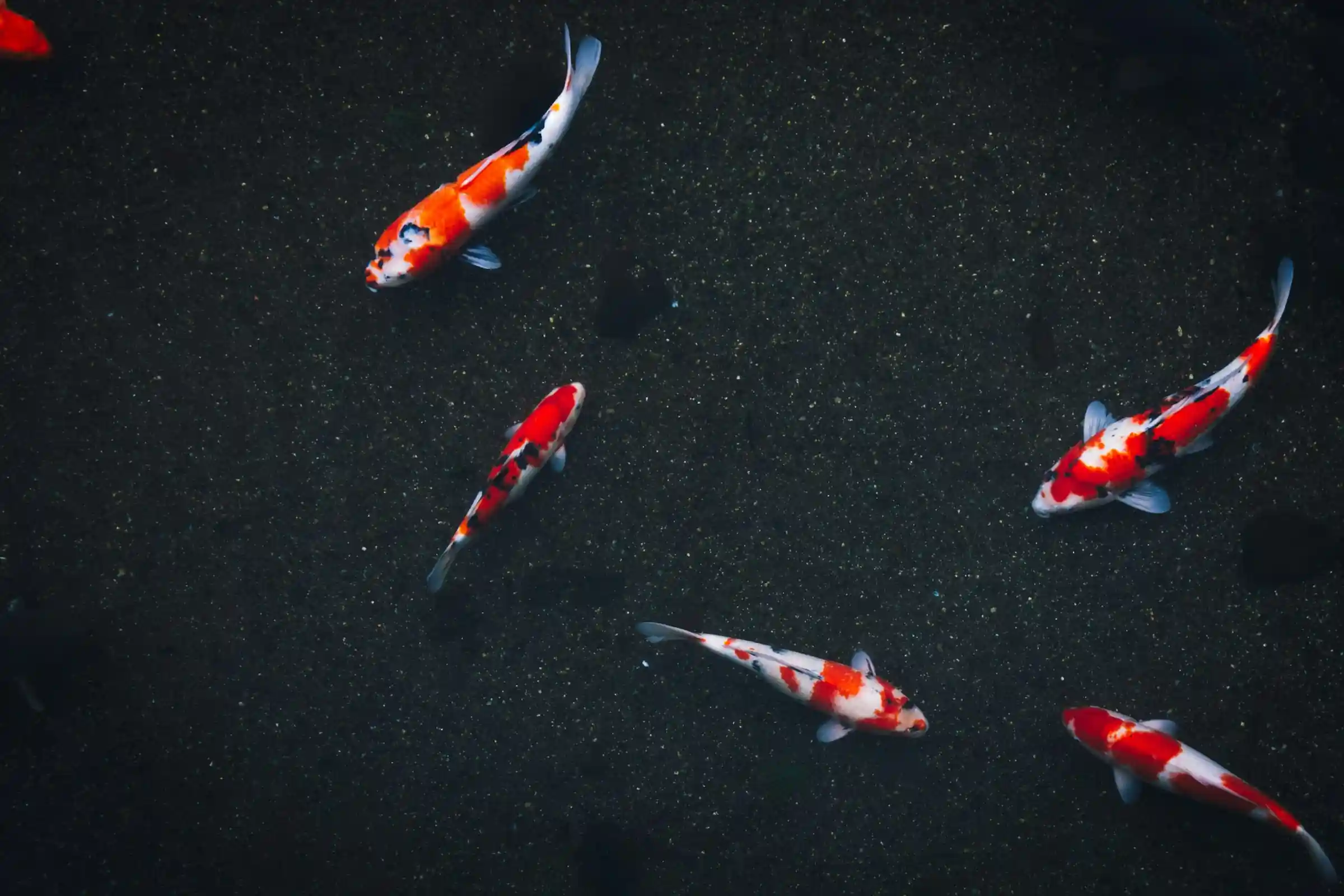
Tancho Showa combines the power of the Showa variety with the iconic red Tancho mark on the head.
The Tancho Showa is a bold and dramatic variety that combines the powerful characteristics of the Showa Sanshoku with the iconic single red mark of the Tancho. It is a tricolor koi, but unlike the Tancho Sanke, it features a heavy black base (Sumi) and white markings (Shiroji), with the red (Hi) limited exclusively to a single spot on the head. This combination results in a koi that feels both traditional and incredibly modern, offering a high-contrast look that is guaranteed to stand out in any collection.
In a Tancho Showa, the quality of the "Sumi" is the driving force behind its visual impact. The black should be deep, glossy, and wrap around the body in large, powerful blocks. The presence of "Motoguro"—black pigment at the base of the pectoral fins—is essential for a classic Showa appearance. The white markings should be clean and provide enough contrast to make the black and red "pop." The defining feature, the red head mark, must be as close to a perfect circle as possible and should ideally be nestled within or adjacent to the black markings on the head, creating a complex and intriguing facial pattern. The interaction between the red Tancho mark and the "Menware" black stripe on the head is particularly fascinating. When the black stripe cuts through or borders the red circle, it creates a sense of movement and drama that is unique to this variety.
The challenge in producing a great Tancho Showa is immense. Not only must the breeder achieve the rare Tancho mutation, but they must also ensure the "Sumi" and "Shiroji" are of high quality and balanced correctly. Because Showa are black-based, the "Sumi" often changes significantly as the fish matures, sometimes rising to cover parts of the red spot or receding to leave the head too white. A mature Tancho Showa that maintains a clean red mark alongside deep, stable black bands is a rare gem in the koi world. It appeals to hobbyists who appreciate the "heavy" and "powerful" aesthetic of the Showa but also desire the symbolic elegance of the Tancho mark. It is a koi of great character and presence, embodying the strength and artistic complexity that defines the peak of Nishikigoi breeding.
Keeping Tancho Showa koi in Southern California
The black (sumi) on these koi can change from season to season. Water temperature, water hardness and minerals all play a part, and a shift in sumi is normal rather than a sign of illness.
Sources disagree on how much sumi moves. One breeder describes true sumi as "stable for the most part", while a Japanese koi-supplement maker says harder water brings sumi out.
The white areas on Shiro Utsuri, Showa and Shiro Bekko carry the same sun risk as Kohaku white skin, so give them partial shade in summer.
Summer care for every koi in SoCal
- Warm water holds less oxygen, yet koi need more oxygen as the water warms. That makes summer the season when oxygen runs shortest.
- Oxygen is usually lowest around dawn, because plants and algae use it up overnight. In summer, keep air stones, waterfalls or fountains running day and night.
- When oxygen runs short, large fish are often the first affected. The bigger and faster-growing your koi, the more aeration matters.
- Published "ideal" ranges vary between sources, from about 59–77°F to 68–78°F. Most sources treat the low-to-mid 80s °F as the point where you should cut feeding, add shade and add aeration.
- At about 82°F and above, feed less than usual. Koi can lose their appetite at 86°F and above, so offer small amounts of an easily digested food and remove anything left uneaten.
- Shade part of the pond, but not all of it, from the afternoon sun. A shade sail, pergola or floating plants will do. Don't enclose the surface so tightly that air can't move over it.
- Inland SoCal is much hotter than the coast. NOAA's 1991–2020 normals give an average July–August afternoon high of about 95–97°F in Riverside, 83–85°F in Santa Ana and 75–77°F at LAX (air temperature). Inland ponds therefore need the heat measures above sooner and for longer.
Key Traits
Renowned Breeders
Expert Advice
Planning a Pond?
Our team can help you select the perfect Tancho Showa koi and design a filtration system tailored to your goals.
Start Consultation