
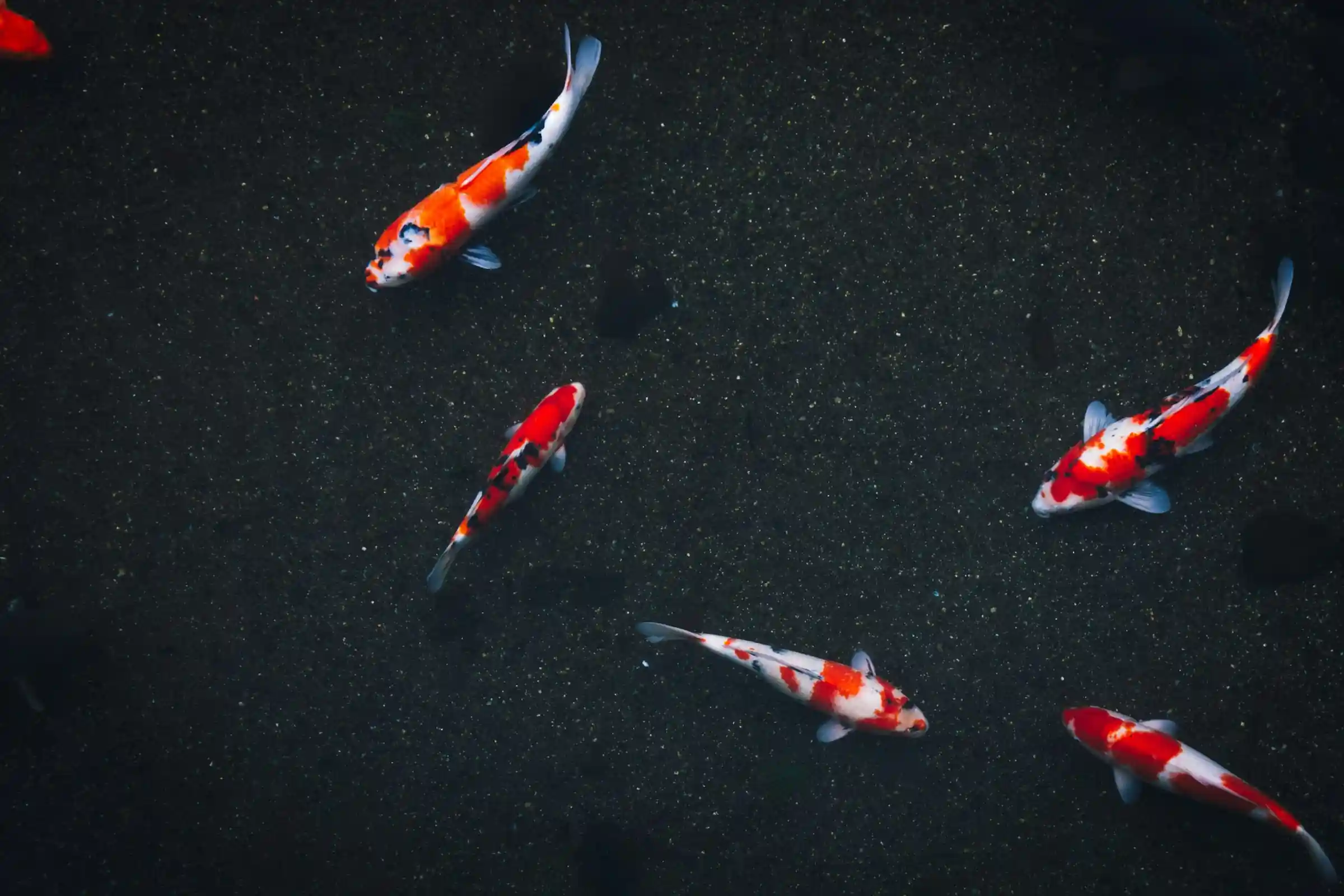
The Tancho koi is highly prized for its resemblance to the Japanese flag, featuring a single red circle on its head.
The Tancho koi is a variety that holds a special place in the hearts of the Japanese people and koi enthusiasts worldwide. It is named after the Japanese Red-crowned Crane (Tancho Tsuru), which features a distinctive red patch on its head. Similarly, a Tancho koi is defined by a single round red mark (ideally circular) on its forehead, with no other red markings anywhere else on its body. This striking resemblance to the "Hinomaru" (the sun disk on the Japanese national flag) makes the Tancho a powerful symbol of national pride and a highly coveted addition to any pond.
The allure of the Tancho lies in its simplicity and the perfection of its single mark. While the red spot can appear on several different varieties, the most common are the Tancho Kohaku, Tancho Sanke, and Tancho Showa. Regardless of the base variety, the criteria for a "perfect" Tancho are exceptionally rigorous. The red spot should ideally be circular, though heart or oval shapes are sometimes accepted if they are symmetrical and well-centered between the eyes and the nostrils. The color should be a deep, uniform crimson, and the edges (Kiwa) should be sharp and clean, without any bleeding into the surrounding skin. The red pigment must be thick enough that the underlying skin color does not bleed through, a quality known as "depth of Hi."
Because the Tancho mark is a mutation and not a guaranteed trait, high-quality koi are relatively rare. Even when two Tancho parents are bred, only a small percentage of the offspring will possess the desired single head mark without other red spots on the body. This rarity, combined with its cultural significance, often drives up the value of exceptional Tancho koi. In a pond, a Tancho acts as a focal point, its clean lines and iconic mark standing out among more complex patterns. It is a variety that emphasizes the importance of negative space and balance in Nishikigoi appreciation. For many collectors, owning a high-quality Tancho is a milestone, representing a deep connection to the history and symbolism of this living art form.
Keeping Tancho koi in Southern California
The white skin (shiroji) is the part of these koi most likely to burn in strong sun. The typical sign is a red rash on the back, and shading the pond for at least two weeks lets it settle.
The red (hi) depends on carotenoids in the diet, and warm, stable water helps koi absorb them. Red that fades after stress often does not come back, so heat stress is worth avoiding.
Some sun is good for colour. Partial shade suits these fish better than full shade. This applies to doitsu (scaleless) Kohaku and Sanke too: a breeder's documented sunburn case found no difference between scaleless and fully scaled fish.
Summer care for every koi in SoCal
- Warm water holds less oxygen, yet koi need more oxygen as the water warms. That makes summer the season when oxygen runs shortest.
- Oxygen is usually lowest around dawn, because plants and algae use it up overnight. In summer, keep air stones, waterfalls or fountains running day and night.
- When oxygen runs short, large fish are often the first affected. The bigger and faster-growing your koi, the more aeration matters.
- Published "ideal" ranges vary between sources, from about 59–77°F to 68–78°F. Most sources treat the low-to-mid 80s °F as the point where you should cut feeding, add shade and add aeration.
- At about 82°F and above, feed less than usual. Koi can lose their appetite at 86°F and above, so offer small amounts of an easily digested food and remove anything left uneaten.
- Shade part of the pond, but not all of it, from the afternoon sun. A shade sail, pergola or floating plants will do. Don't enclose the surface so tightly that air can't move over it.
- Inland SoCal is much hotter than the coast. NOAA's 1991–2020 normals give an average July–August afternoon high of about 95–97°F in Riverside, 83–85°F in Santa Ana and 75–77°F at LAX (air temperature). Inland ponds therefore need the heat measures above sooner and for longer.
Key Traits
Renowned Breeders
Expert Advice
Planning a Pond?
Our team can help you select the perfect Tancho koi and design a filtration system tailored to your goals.
Start Consultation