
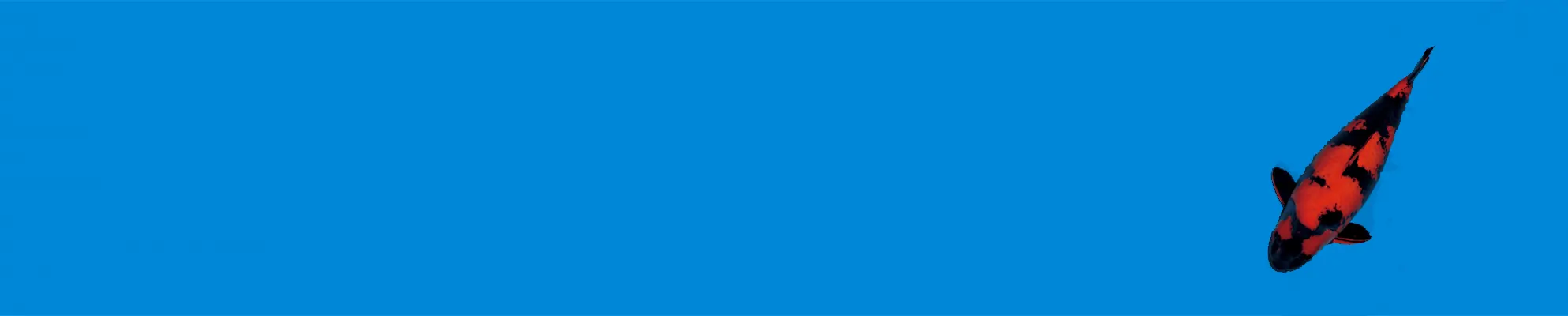
Hi Utsuri Koi bring fire to the water with their dramatic red and black patterns. Discover why this variety is a centerpiece of many ponds.
Hi Utsuri is a variety that brings a sense of fire and shadow to the koi pond. Belonging to the Utsurimono lineage, it consists of a deep black (Sumi) base overlaid with vibrant red or orange (Hi) patterns. The visual impact of a Hi Utsuri is akin to embers glowing in the dark, and it is often one of the first fish a visitor will notice in a collection. Unlike the Shiro Utsuri, which seeks a clean and stark contrast, the Hi Utsuri aims for a rich, saturated warmth. The black pattern should be bold and 'wrap' around the body, ideally forming a balanced, interlocking design with the red. One of the classic traits sought by judges is a 'Menware' pattern—a black marking that divides the head. The red color, or Hi, should be uniform across the entire fish; any fading or yellowish tint is considered a weakness. While they are incredibly popular for their dramatic looks, Hi Utsuri are notoriously difficult to breed to a high standard. The black often has a tendency to become 'messy' or develop small spots (shimi) within the red areas, which can distract from the overall flow of the pattern. Breeders like Shinoda have spent decades perfecting the stability of the Sumi in this variety, ensuring that the black stays dark and lacquer-like even as the fish grows. In a pond, the Hi Utsuri provides a wonderful bridge between the cooler blue/white varieties and the warmer metallic ones. Its presence adds a layer of mystery and depth, particularly when viewed in the shifting light of dusk or dawn, where the red seems to glow from within the black frame.
Keeping Hi Utsuri koi in Southern California
The black (sumi) on these koi can change from season to season. Water temperature, water hardness and minerals all play a part, and a shift in sumi is normal rather than a sign of illness.
Sources disagree on how much sumi moves. One breeder describes true sumi as "stable for the most part", while a Japanese koi-supplement maker says harder water brings sumi out.
The white areas on Shiro Utsuri, Showa and Shiro Bekko carry the same sun risk as Kohaku white skin, so give them partial shade in summer.
Summer care for every koi in SoCal
- Warm water holds less oxygen, yet koi need more oxygen as the water warms. That makes summer the season when oxygen runs shortest.
- Oxygen is usually lowest around dawn, because plants and algae use it up overnight. In summer, keep air stones, waterfalls or fountains running day and night.
- When oxygen runs short, large fish are often the first affected. The bigger and faster-growing your koi, the more aeration matters.
- Published "ideal" ranges vary between sources, from about 59–77°F to 68–78°F. Most sources treat the low-to-mid 80s °F as the point where you should cut feeding, add shade and add aeration.
- At about 82°F and above, feed less than usual. Koi can lose their appetite at 86°F and above, so offer small amounts of an easily digested food and remove anything left uneaten.
- Shade part of the pond, but not all of it, from the afternoon sun. A shade sail, pergola or floating plants will do. Don't enclose the surface so tightly that air can't move over it.
- Inland SoCal is much hotter than the coast. NOAA's 1991–2020 normals give an average July–August afternoon high of about 95–97°F in Riverside, 83–85°F in Santa Ana and 75–77°F at LAX (air temperature). Inland ponds therefore need the heat measures above sooner and for longer.
Key Traits
Renowned Breeders
Expert Advice
Planning a Pond?
Our team can help you select the perfect Hi Utsuri koi and design a filtration system tailored to your goals.
Start Consultation